Image Generated With GPT Image 2.0
AI Infrastructure Is Becoming A System Problem
Artificial intelligence is changing the way computing infrastructure is designed. Scaling AI is no longer only about deploying more powerful accelerators. Every increase in compute capability creates additional requirements for memory bandwidth, data movement, networking, power delivery, cooling, storage, and system management. As AI clusters grow from individual servers to thousands of interconnected accelerators, the performance of the overall infrastructure increasingly depends on how effectively these technologies operate together.
This makes AI Infrastructure fundamentally different from traditional computing environments. The objective is not simply to maximize processor performance, but to ensure that compute resources remain supplied with data, efficiently connected, adequately powered, properly cooled, and highly utilized. Semiconductors sit at the center of nearly every one of these considerations.
The Components Behind The Compute
An AI server contains far more semiconductor technology than the accelerator itself. CPUs coordinate workloads, accelerators perform AI computation, high-bandwidth memory keeps data close to the compute engines, networking devices connect processors and servers, storage devices supply datasets, and power semiconductors manage increasingly demanding electrical requirements.
As infrastructure becomes more complex, each of these components can influence the performance and scalability of the overall system.
| Infrastructure Area | Key Semiconductor Components | Primary Consideration |
|---|---|---|
| Compute | GPUs, AI accelerators, CPUs, custom silicon | Performance, utilization, energy efficiency |
| Memory | HBM, DRAM | Bandwidth, capacity, data proximity |
| Networking | Switch ASICs, NICs, DPUs, SerDes | Bandwidth, latency, scalability |
| Interconnect | Chiplet interfaces, high-speed I/O, optical devices | Efficient data movement |
| Storage | NAND, SSD controllers, NVMe devices | Dataset access and throughput |
| Power | PMICs, voltage regulators, GaN and SiC devices | Power conversion and efficiency |
| Monitoring | Sensors, controllers, management silicon | Reliability, thermal and system control |
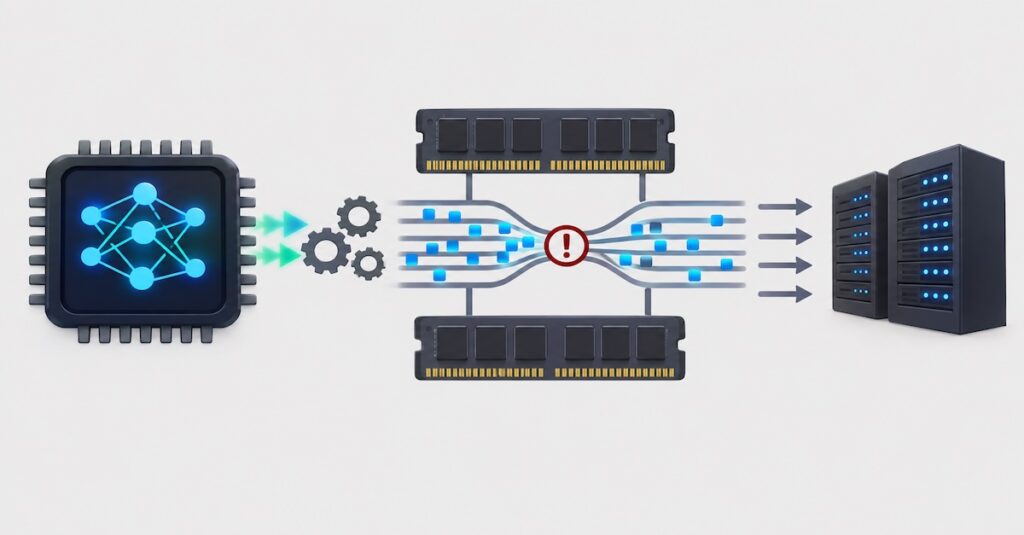
The growing importance of these supporting technologies also changes where performance bottlenecks can emerge. A faster accelerator provides limited benefit if memory cannot provide data quickly enough. Additional servers provide limited scalability if networking becomes congested. Higher chip density creates new challenges if power delivery and cooling cannot scale with it.
AI infrastructure therefore needs to be considered as an interconnected semiconductor system rather than a collection of independent components.
The Capital Cost Of Scaling AI
The semiconductor requirements of AI infrastructure also have significant capital implications. Building larger AI clusters requires much more than purchasing additional accelerators. Higher compute density increases demand for HBM, advanced networking equipment, storage capacity, power infrastructure, cooling systems, and increasingly sophisticated semiconductor packaging.
The cost of scaling therefore expands across several layers simultaneously.
Advanced AI processors are expensive to manufacture because they rely on leading-edge process technologies and large amounts of silicon. HBM adds significant memory content around each accelerator. Advanced packaging connects these devices through increasingly complex substrates, interposers, and chiplet architectures. High-speed networking infrastructure must then connect accelerators across servers, racks, and eventually entire data centers.
Power infrastructure introduces another major capital requirement. Large AI clusters can consume enormous amounts of electricity, requiring investment in power distribution, conversion equipment, backup systems, and cooling infrastructure.
This means that AI infrastructure capital expenditure cannot be evaluated solely through the cost of compute. The more meaningful consideration is the total cost of delivering usable computation.
Infrastructure providers increasingly have to evaluate how much performance they receive relative to the combined cost of compute, memory, networking, power, cooling, and supporting infrastructure.
What Infrastructure Designers Must Balance
As AI systems scale, infrastructure design increasingly becomes a balancing exercise across compute, memory, networking, packaging, power, and cooling. Improving one part of the system often creates additional pressure elsewhere.
More accelerator performance requires greater memory bandwidth, larger clusters demand faster interconnects, and higher compute density increases power and thermal requirements. The objective is therefore not simply to maximize compute, but to ensure that the entire system can operate efficiently and remain highly utilized.
| Consideration | Why It Matters |
|---|---|
| Compute Utilization | Determines how effectively accelerators are used |
| Memory Bandwidth | Keeps processors supplied with data |
| Data Movement | Affects latency and energy consumption |
| Networking | Enables efficient cluster scaling |
| Power & Cooling | Sets limits on compute density |
| Advanced Packaging | Integrates compute, memory, and chiplets more closely |
Together, these factors show why AI infrastructure increasingly needs to be designed and optimized at the system level.