Image Generated With GPT Image 2.0
Silicon Data Evolution
The semiconductor industry has always depended on data. However, the role of data has fundamentally changed over the last decade. Historically, data was collected primarily to monitor manufacturing processes, track yield, and identify failures. Today, data has become a strategic asset that directly influences product performance, manufacturing efficiency, quality, reliability, and profitability.
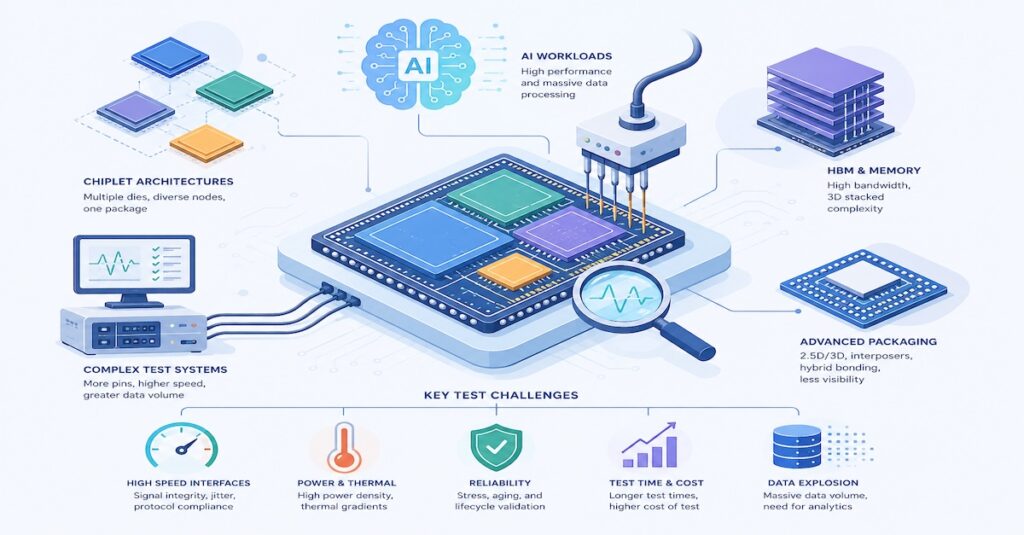
As semiconductor products become more complex through advanced process nodes, heterogeneous integration, chiplet architectures, High Bandwidth Memory (HBM), and advanced packaging technologies, the volume and complexity of semiconductor data continue to grow. Every stage of the product lifecycle generates valuable information, including design simulations, process measurements, wafer sort results, assembly records, final test outcomes, system-level test data, reliability characterization, and field-return analysis.
The challenge is no longer collecting data. The challenge is converting massive amounts of fragmented information into actionable intelligence. This is where semiconductor data tools have become critical. These tools provide the infrastructure required to collect, correlate, analyze, and operationalize semiconductor data across the entire product lifecycle.
Semiconductor Data Tools Are Becoming A Manufacturing Necessity
Modern semiconductor manufacturing generates billions of data points every day. A single wafer may produce thousands of devices, each containing hundreds or thousands of test measurements. When multiplied across wafer fabrication, assembly, package qualification, final test, burn-in, and system-level test, the resulting data volume becomes enormous.
Traditional data management approaches were designed for isolated manufacturing stages. Process engineers maintained fabrication databases, assembly teams managed packaging records, and test organizations stored electrical test results independently. While these systems supported local optimization, they created significant visibility gaps across the product lifecycle. Semiconductor data tools address this challenge by creating a unified framework that integrates information from multiple manufacturing and test operations. These platforms enable engineers to establish traceability from wafer fabrication through final shipment while maintaining device-level visibility.
The value of these tools extends beyond data storage. They provide correlation engines, statistical analytics, machine learning capabilities, visualization platforms, root-cause analysis frameworks, and predictive modeling infrastructure. Together, these capabilities transform semiconductor data from a historical record into an active decision-making system.
As manufacturing complexity increases, semiconductor companies can no longer rely on disconnected databases and manual analysis. Data tools are becoming as essential to productization as process technology, packaging capability, and test infrastructure.
The Evolution Of Semiconductor Data Tool Requirements
The requirements placed on semiconductor data tools have expanded significantly as semiconductor products have evolved.
Historically, manufacturing organizations focused on yield reporting, defect tracking, and basic statistical process control. The objective was primarily reactive. Engineers analyzed failures after they occurred and implemented corrective actions to stabilize production.
Today, the expectations are substantially higher. Semiconductor data tools must support rapid product ramps, advanced packaging integration, chiplet assembly, High Bandwidth Memory integration, reliability prediction, and field-quality monitoring. They must process structured and unstructured data while maintaining real-time visibility across global manufacturing networks.
Several capabilities have become increasingly important:
- Device-level traceability across the complete product lifecycle
- Correlation of process, assembly, package, and test data
- Real-time excursion detection and containment
- Predictive yield and quality analytics
- Machine learning-assisted root-cause analysis
- Reliability and lifecycle risk assessment
- Adaptive screening and dynamic test optimization
The growing adoption of artificial intelligence further increases the demand for high-quality semiconductor data infrastructure. AI algorithms are only as effective as the quality and completeness of the underlying data. Organizations with fragmented data environments often struggle to fully leverage advanced analytics despite significant investments in machine learning technologies.
The future competitive advantage will belong to companies capable of creating a continuous data thread connecting design, manufacturing, test, qualification, and field operation.
Current Status And Use Cases Of Semiconductor Data Tools
The semiconductor industry is currently transitioning from isolated manufacturing analytics toward lifecycle-driven data intelligence. While many organizations have deployed advanced analytics platforms, maturity levels vary significantly across the industry. Several high-value use cases are driving adoption.
| Area | Traditional Environment | Modern Data Tool Environment |
|---|---|---|
| Data Architecture | Multiple disconnected databases | Unified lifecycle data platform |
| Traceability | Lot-level tracking | Device-level traceability |
| Yield Analysis | Historical reporting | Predictive yield analytics |
| Failure Analysis | Manual correlation and offline investigations | Automated root-cause identification and correlation |
| Quality Control | Reactive containment after excursions | Predictive quality monitoring and early detection |
| Test Optimization | Static test programs and fixed guardbands | Adaptive test strategies and dynamic screening |
| Reliability Management | Qualification-focused assessment | Continuous lifecycle reliability monitoring |
| Decision Speed | Days or weeks to identify issues | Real-time operational intelligence and decision-making |
Yield learning remains one of the most important applications. Data tools correlate wafer process parameters, assembly conditions, and test signatures to identify yield loss mechanisms faster than traditional analysis methods.
Advanced packaging introduces additional complexity requiring correlation across multiple dies, package structures, interconnect technologies, and memory subsystems. Semiconductor data tools help engineers identify interactions between assembly processes and electrical performance.
Quality and reliability management represent another critical application. Data platforms enable early identification of latent defects, process excursions, and reliability risks before they impact customers.
Many organizations are also using data tools to optimize test operations. By analyzing historical test behavior, engineers can eliminate redundant test content, refine guardbands, and improve screening efficiency without compromising outgoing quality.
The result is a more intelligent manufacturing environment where decisions are driven by real-time evidence rather than historical assumptions.