Image Generated With GPT Image 2.0
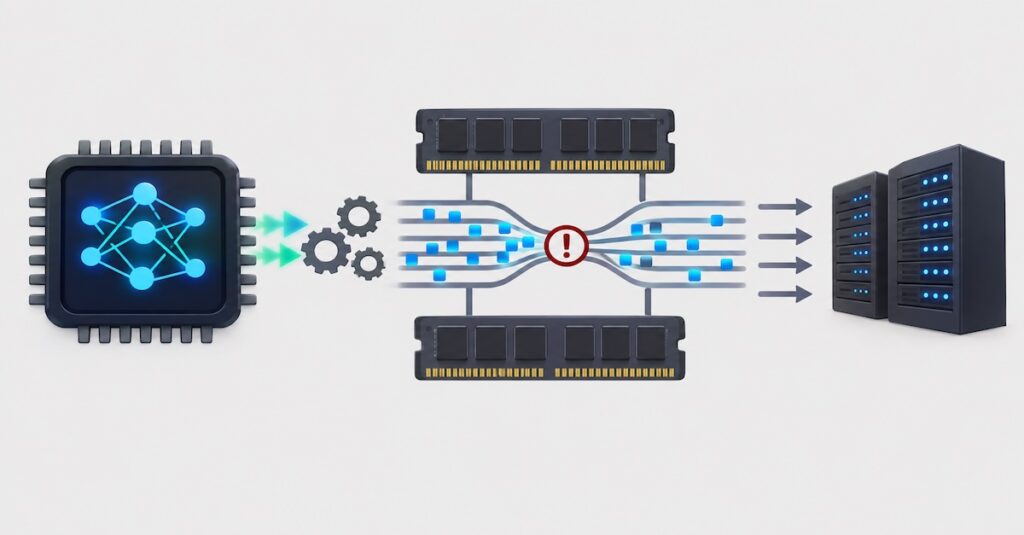
AI Compute Is Only As Fast As The Data Feeding It
For decades, semiconductor progress was closely associated with increasing compute capability. More transistors, higher clock speeds, greater parallelism, and increasingly specialized architectures enabled processors to perform more operations with each generation.
AI has accelerated this progression dramatically. Modern AI accelerators can execute enormous numbers of mathematical operations in parallel, but as computational capability continues to grow, another challenge is becoming just as important: keeping those compute engines continuously supplied with data.
In other words, AI hardware does not simply need to compute faster; it also needs to move enormous volumes of data efficiently between memory, processors, accelerators, servers, and increasingly, entire clusters. As a result, data movement is becoming one of the defining semiconductor challenges of the AI era.
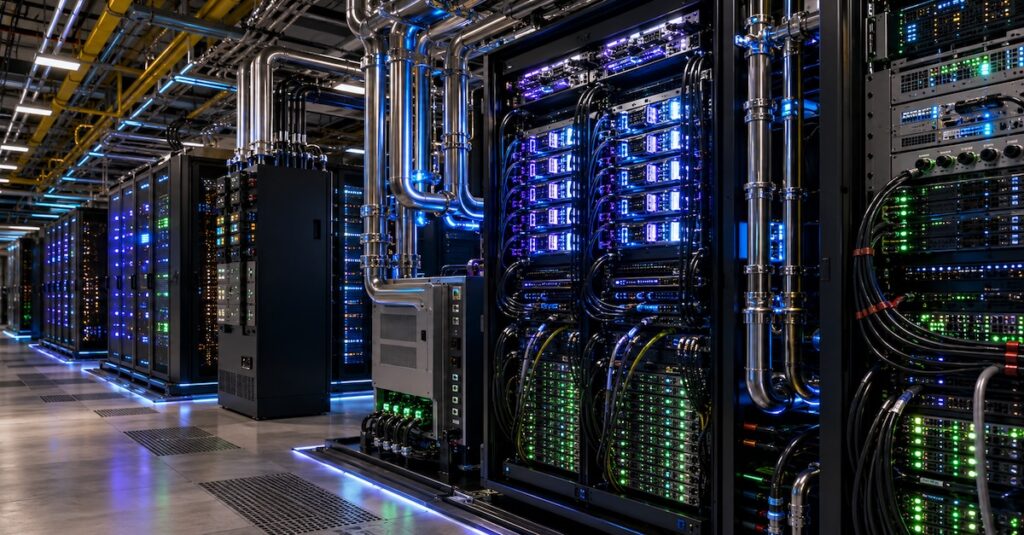
The reason becomes clear when we look at how an AI workload moves through a modern data center. Data may first enter through networking infrastructure before being stored locally. From there, it can move through CPUs, system memory, accelerators, and specialized data-processing devices. Within the accelerator itself, model parameters and intermediate results must continually move between compute logic and high-bandwidth memory. And when workloads span multiple accelerators, that movement extends further across processors, servers, racks, and eventually entire clusters.
At every stage, moving data introduces latency, consumes power, and creates the potential for new bottlenecks. A compute engine may be capable of processing enormous amounts of information, but that capability matters only if the surrounding semiconductor system can deliver the required data quickly and efficiently enough to keep it productive.
Keeping Data Closer To Compute
One of the clearest semiconductor responses to this challenge has been the rapid adoption of high-bandwidth memory.
Traditional memory architectures place memory relatively far from the processor and rely on narrower interfaces to move data back and forth. As AI accelerators demand significantly greater memory bandwidth, this approach becomes increasingly limiting. HBM addresses the problem by placing stacked memory much closer to the accelerator and connecting it through wide, high-density interfaces capable of moving far more data in parallel.
This changes the performance equation. Instead of focusing only on how much compute can be integrated onto a die, system designers must also consider how quickly and efficiently data can be delivered to that compute.
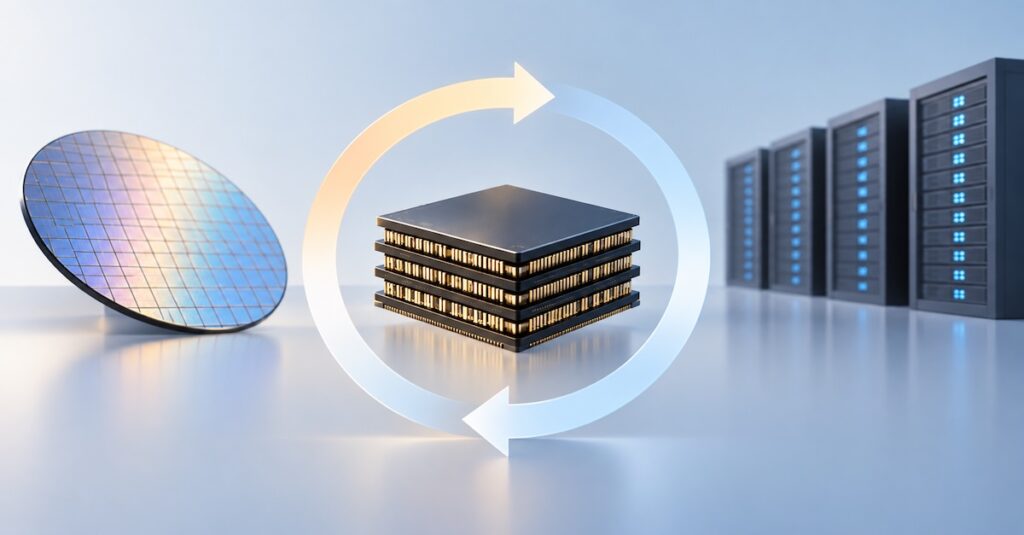
That requirement has also increased the importance of advanced packaging. Technologies such as 2.5D integration allow logic and HBM to be placed in close proximity within the same package, creating high-bandwidth connections while reducing the physical distance data must travel.
Together, these developments represent an important architectural shift. AI system performance is increasingly determined not only by the capability of the compute engine, but also by the efficiency of the memory and interconnect architecture surrounding it.
The Challenge Extends Beyond The Package
Moving data efficiently within a package solves only part of the challenge.
Large AI workloads increasingly operate across many accelerators, which means performance depends not only on communication between compute and memory, but also on communication between processors. Training large models can require thousands of accelerators working together while continuously exchanging parameters, gradients, model states, and intermediate results.
As a result, accelerator-to-accelerator communication is becoming an integral part of the compute architecture itself. A high-performance accelerator that spends too much time waiting for data is underutilized silicon, while a cluster of thousands of accelerators waiting on one another creates an even larger system-level inefficiency.
This is why networking silicon is becoming increasingly important to AI hardware. High-speed SerDes, network interface controllers, DPUs, switches, accelerator interconnects, and optical links all play a growing role in moving data efficiently across servers and clusters.
AI infrastructure therefore depends not on a single class of processor, but on a broader semiconductor ecosystem working together to move, store, process, and manage data. Compute may receive most of the attention, but overall system performance increasingly depends on how effectively these components communicate with one another.
Advanced Packaging Is Also A Data-Movement Technology
Advanced packaging is often described as a way to continue semiconductor scaling beyond the limits of a single monolithic die, but in AI hardware its role is becoming much broader. Packaging is increasingly shaping how efficiently data moves between compute, memory, and specialized functions.
Placing HBM close to accelerator logic shortens the path between memory and compute, while integrating multiple chiplets within the same package allows different functions to communicate through high-bandwidth die-to-die interfaces. Technologies such as silicon interposers, bridges, hybrid bonding, and 3D integration further reduce the physical distance that data must travel.
This matters because moving data consumes both time and energy. As AI systems become larger and more complex, reducing unnecessary data movement becomes increasingly important for performance and power efficiency. Semiconductor architecture and packaging architecture are therefore becoming more tightly connected, requiring designers to consider not only what functions belong in the system, but also where those functions should physically reside relative to memory, I/O, and compute.
The question is no longer simply how much compute can be built, but how efficiently everything around that compute can be connected.
The Next Semiconductor Scaling Curve
None of this means compute innovation is becoming less important. AI will continue to demand better transistor technologies, more specialized architectures, higher computational density, and more efficient accelerators. But increasing compute without a corresponding improvement in data movement eventually leads to diminishing returns.
This is why many of the most important semiconductor technologies for AI now sit around the compute engine rather than inside it. HBM increases bandwidth close to the processor, advanced packaging brings memory and compute closer together, chiplets enable specialized functions to communicate through high-speed interfaces, networking silicon connects accelerators across servers and clusters, and optical technologies may eventually provide a more scalable way to move enormous amounts of data over longer distances.
Taken together, these developments point to a broader shift in how semiconductor performance should be viewed. For decades, the industry focused heavily on increasing the amount of computation available on a chip, but in the AI era, the processor is only one part of a much larger semiconductor system. AI hardware performance will increasingly depend on how quickly, efficiently, and reliably data can move through that system.
The semiconductor industry has become exceptionally good at building machines capable of enormous amounts of computation; the next challenge is making sure the data can keep up.