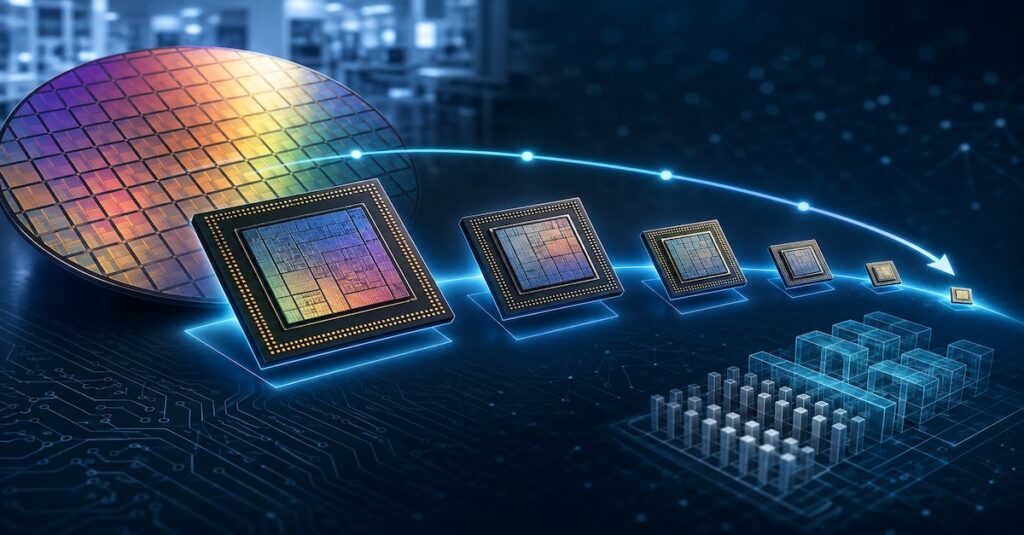
Image Generated With GPT Image 2.0
AI And Data Center
Artificial intelligence is often portrayed as a software revolution powered by increasingly capable GPUs. While AI models and accelerators dominate headlines, they represent only one layer of a far more complex technology stack. Every AI query, every model training run, and every inference ultimately depends on an ecosystem of semiconductor technologies working together.
Modern AI infrastructure extends far beyond compute accelerators. It integrates high-bandwidth memory, general-purpose processors, networking silicon, power management devices, storage controllers, advanced packaging, optical interconnects, and numerous supporting semiconductor technologies into a highly coordinated system. Each component performs a specialized function, and the overall performance, scalability, and energy efficiency of an AI data center depend on how effectively these technologies operate together.
This represents an important shift in how we should think about AI. For decades, advances in computing were largely associated with faster processors and smaller transistors. Today, the performance of an AI data center depends on the coordinated operation of thousands of semiconductor devices distributed across every server and every rack. In many ways, today’s AI data center is better described as a semiconductor data center, where system-level integration has become as important as advances in individual chips.
Beyond The GPU
When people discuss AI infrastructure, the conversation almost always begins with GPUs. That focus is understandable, as AI accelerators perform the massive parallel computations required for training and inference. However, a GPU cannot operate in isolation.
Every AI server also depends on high-bandwidth memory (HBM) to feed data to the processors, high-performance CPUs to manage workloads, networking ASICs to connect thousands of accelerators, data processing units (DPUs) to offload infrastructure tasks, storage controllers to manage vast datasets, power management ICs to regulate increasingly demanding power requirements, optical transceivers to move data efficiently between systems, and embedded management and security processors to monitor and protect the platform. Each of these components is a highly sophisticated semiconductor product designed for a specific role within the larger AI system.
| Traditional Data Center | AI Data Center |
|---|---|
| CPU-centric architecture | Semiconductor ecosystem-centric architecture |
| Compute dominates performance | Compute, memory, networking, and power collectively determine performance |
| Individual processor optimization | System-level semiconductor optimization |
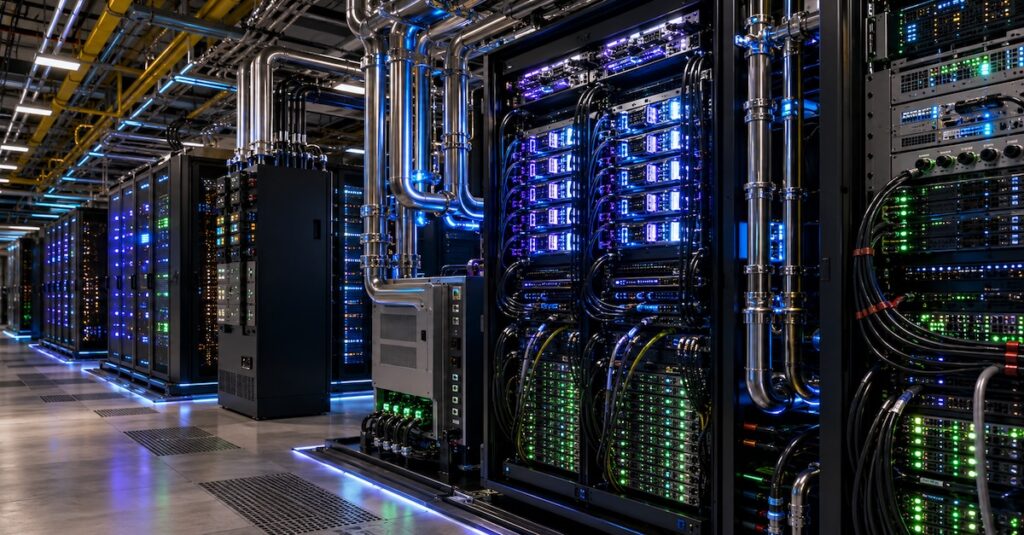
| Air cooling is sufficient | Advanced liquid cooling is increasingly required |
| Memory supports compute | Memory enables compute scalability |
| Limited accelerator deployment | Thousands of tightly interconnected accelerators |
The scale of semiconductor integration is remarkable. According to the SIA, a single state-of-the-art AI server rack can contain more than 4,500 packaged semiconductor devices and nearly 20,000 individual semiconductor dies. This number alone demonstrates that AI infrastructure is no longer defined by a single processor. It is defined by the integration of thousands of semiconductor components working as a unified system.
Data Center Driven By Entire Semiconductor Ecosystem
The rapid expansion of artificial intelligence has fundamentally changed the architecture of modern data centers. In the past, data center performance was largely defined by the capability of its CPUs and storage infrastructure.
Today, AI workloads require an entirely different computing platform where multiple semiconductor technologies operate together as an integrated system. The performance of an AI data center is no longer determined by the processor alone, but by the collective capability of compute, memory, networking, power delivery, storage, and advanced packaging technologies.
Every AI server integrates a broad range of semiconductor technologies that work together as a unified system. Specialized AI accelerators provide the computational capability for training and inference, while high-bandwidth memory supplies the data required to keep these processors fully utilized. Networking silicon connects thousands of accelerators into large-scale computing clusters, storage controllers manage massive AI datasets, power management devices deliver stable and efficient power, security processors protect the platform, and optical interconnects enable high-speed communication between systems.
Each device addresses a unique engineering challenge, yet together they determine the throughput, scalability, reliability, and energy efficiency of the entire AI infrastructure.
| Semiconductor Technology | Primary Role in AI Data Center | Why It Matters |
|---|---|---|
| AI Accelerators (GPUs/AI ASICs) | Execute AI training and inference | Deliver massive parallel compute performance |
| CPUs | System orchestration and workload management | Coordinate applications, scheduling, and operating systems |
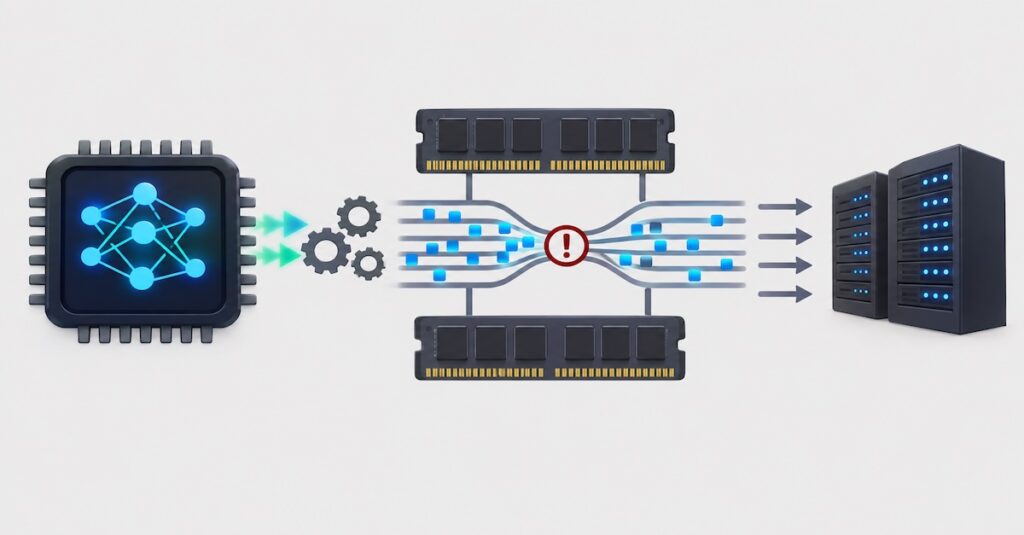
| High Bandwidth Memory (HBM) | High-speed data access | Eliminates memory bandwidth bottlenecks for AI workloads |
| Networking ASICs & NICs | Connect servers and accelerator clusters | Enable distributed AI training across thousands of processors |
| Data Processing Units (DPUs) | Infrastructure acceleration | Offload networking, storage, and security functions from CPUs |
| Storage Controllers | Manage large AI datasets | Sustain high-speed data movement during training and inference |
| Power Management ICs (PMICs) | Regulate and distribute power | Maintain stable operation for increasingly power-hungry systems |
| Silicon Photonics & Optical Modules | High-speed optical communication | Improve bandwidth while reducing power consumption over long distances |
| Embedded Management & Security Controllers | Platform monitoring and security | Ensure system reliability, health monitoring, and secure operation |
This diversity of semiconductor technologies demonstrates that AI infrastructure is fundamentally a systems engineering challenge. Improving only one component rarely improves overall performance. Faster accelerators provide limited benefit if memory bandwidth cannot supply data, networking cannot move information efficiently, or power delivery and cooling cannot support higher computational density.
Consequently, innovation is increasingly focused on optimizing the interaction between semiconductor technologies rather than maximizing the performance of any individual device.
This shift also explains why AI is driving growth across nearly every segment of the semiconductor industry. While AI accelerators remain the most visible products, advances in memory, networking, analog, power management, photonics, advanced packaging, and embedded control have become equally important in enabling next-generation AI data centers.
The AI revolution is therefore creating demand not for a single category of semiconductor, but for an entire semiconductor ecosystem working together as one integrated platform.