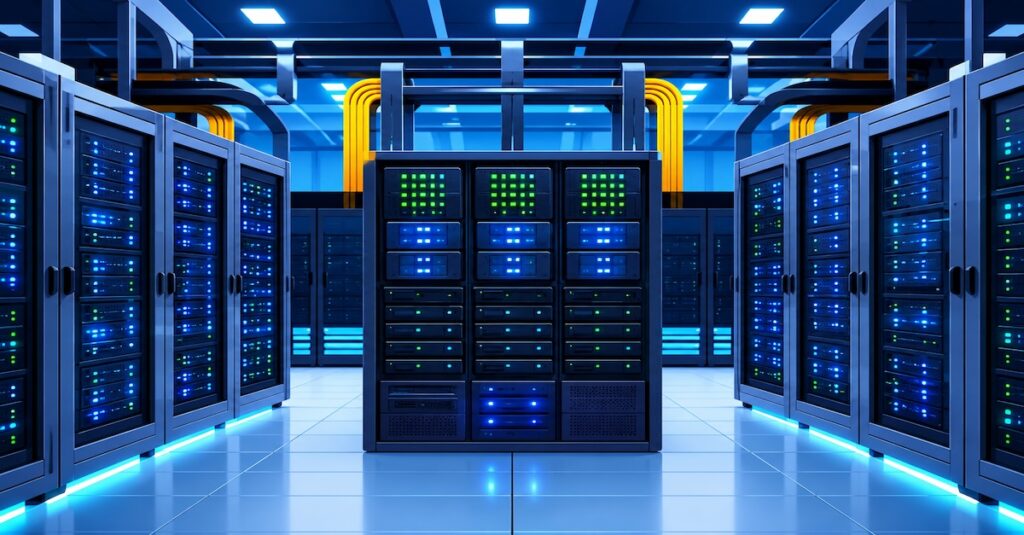
Image Generated With GPT Image 2.0
An AI Server Is More Than An AI Accelerator
Artificial intelligence is often associated with powerful GPUs and AI accelerators, but these processors represent only one portion of the semiconductor content inside a modern AI server. Delivering large-scale AI training and inference requires a tightly integrated collection of semiconductor devices, each optimized for a specific function.
Alongside AI accelerators are host CPUs that manage system operations, high-bandwidth memory (HBM) that supplies data at unprecedented speeds, networking silicon that enables communication across thousands of servers, storage controllers that move massive datasets, power management integrated circuits (PMICs) that regulate hundreds of amperes of current, security processors that protect hardware and data, timing devices that synchronize high-speed interfaces, and numerous analog and sensor devices that ensure reliable operation.
As AI models continue to grow in size and complexity, the number, diversity, and performance requirements of these semiconductor devices increase together. An AI server has therefore evolved into a highly integrated semiconductor platform in which computing, memory, networking, power delivery, storage, and system management operate as a unified architecture.
Overall system performance depends not only on the capability of the AI accelerator but also on the efficiency with which these semiconductor technologies interact to deliver data, distribute power, maintain synchronization, and sustain reliable operation under demanding workloads.
The Semiconductor Ecosystem Inside An AI Server
Each semiconductor device within an AI server performs a specialized function, yet all must operate together to maximize computational throughput and overall system efficiency. AI accelerators execute machine learning workloads, while CPUs coordinate operating system functions, workload scheduling, and communication with peripheral devices.
High-bandwidth memory provides the data bandwidth required to keep accelerators fully utilized, networking devices connect servers into large AI clusters, storage controllers manage movement of training datasets, and power management devices maintain stable power delivery despite rapidly changing current demands. Supporting devices, including timing generators, security processors, sensors, and interface controllers, provide synchronization, system monitoring, and hardware security that enable reliable large-scale operation.
| Semiconductor Device | Primary Function in an AI Server |
|---|---|
| AI Accelerator (GPU/AI Processor) | Executes AI training and inference workloads |
| Host CPU | Manages system software, scheduling, and I/O operations |
| High-Bandwidth Memory (HBM) | Provides extremely high memory bandwidth to accelerators |
| Networking Silicon (NICs/Switches) | Enables high-speed communication within AI clusters |
| Storage Controller | Transfers and manages large AI datasets |
| Power Management ICs (PMICs) | Regulates voltage and supplies high current to processors and memory |
| Security Processor | Protects firmware, authentication, and secure system boot |
| Clock and Timing Devices | Synchronize processors, memory, and high-speed interfaces |
| Sensors and Monitoring ICs | Monitor temperature, voltage, current, and system health |
Although AI accelerators attract the greatest attention, they depend on every other semiconductor device in the server to sustain performance. The overall capability of an AI server is determined by how effectively these components work together rather than by the compute processor alone.
From Individual Chips To Complete Semiconductor Systems
The rapid expansion of artificial intelligence is transforming AI servers from collections of individual components into highly integrated semiconductor systems. Every advancement in AI computing depends on coordinated improvements across compute processors, memory technologies, networking, power management, storage, security, timing, and system integration.
As accelerator performance continues to increase, these supporting semiconductor technologies become equally important in determining system throughput, scalability, energy efficiency, and reliability.
| Traditional Server | Modern AI Server |
|---|---|
| CPU-centric computing | AI accelerator-centric computing with host CPUs |
| DDR memory | High-Bandwidth Memory (HBM) integrated with accelerators |
| Moderate network bandwidth | Ultra-high-speed networking for distributed AI clusters |
| Conventional storage workloads | Massive AI datasets requiring continuous high-throughput storage |
| Tens to hundreds of watts per processor | Hundreds to over a thousand watts per accelerator |
| Air cooling is often sufficient | Advanced air and increasingly liquid cooling are required |
| Primarily general-purpose computing | Optimized for large-scale AI training and inference |
| Limited semiconductor diversity | Broad ecosystem of compute, memory, networking, power, storage, timing, security, and sensing devices |
This evolution is also creating opportunities across the broader semiconductor industry. Rather than benefiting only accelerator manufacturers, AI infrastructure is driving innovation in memory, analog and power devices, networking silicon, storage, security, advanced packaging, and photonics
The next generation of AI servers will therefore be defined not by a single breakthrough processor, but by continued advances across the entire semiconductor ecosystem that enables AI computing.